



















"Everybody counts or nobody counts." Discover why Bosch on Amazon Prime Video is the undisputed king of modern noir — and why Titus Welliver's Harry Bosch remains the last honest man in the City of Angels.
The Evolution of Harry Bosch: A Character Study in Shadows
Adapted with surgical fidelity from the best-selling crime novels of Michael Connelly and produced exclusively for Amazon Prime Video, Bosch stands as the definitive benchmark for prestige crime drama in the streaming era — a series that arrived quietly, without the marketing thunder of its contemporaries, and proceeded to outlast, outclass, and outwit virtually all of them. This is emphatically not a case-of-the-week procedural dressed up in cinematic clothing. It is a meticulously constructed psychological portrait of Hieronymus "Harry" Bosch — a man forged in the crucible of a traumatic childhood in the Los Angeles foster care system, shaped by military service as a tunnel rat in the jungles of Vietnam, and hardened by three decades spent staring into the moral abyss that churns beneath the glittering, indifferent surface of the city he both loves and despises.
Each of the seven seasons unfolds with the structural patience and thematic density of a literary novel. The series never condescends to its audience, never resorts to cheap cliff-hangers, and never sacrifices character truth for narrative convenience. In an era of prestige television defined by relentless escalation and manufactured spectacle, Bosch chose a different, more demanding path — and the result is one of the most quietly authoritative works of crime fiction the small screen has ever produced.
The Uncompromising Moral Code of Harry Bosch
Titus Welliver does not merely play Harry Bosch — he inhabits him with a stoic, granite authority and a quietly devastating emotional complexity that represents some of the finest character acting in the history of streaming television. Bosch is a man of few words and overwhelming, gravitational presence. His unshakeable moral code — his absolute, non-negotiable refusal to accommodate the cynical political machinery of the LAPD, the District Attorney's office, or the city's moneyed power structures — makes him a protagonist who is as fascinating as he is, at times, infuriating. The series is bold enough, and intelligent enough, to allow Bosch to be genuinely, uncomfortably unlikeable: stubborn to the point of self-destruction, tunnel-visioned in his pursuit of justice, and emotionally remote in ways that cost him marriages, friendships, and careers.
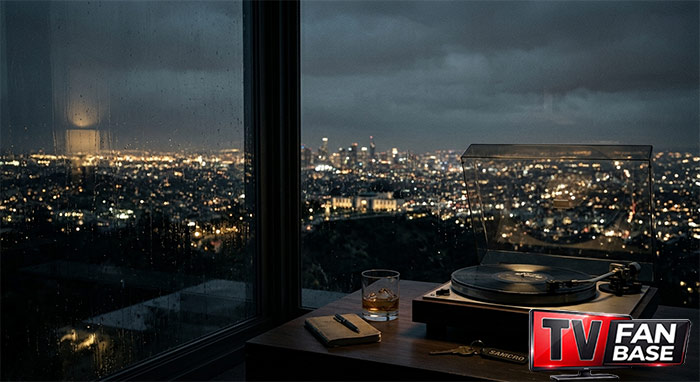
It is precisely this creative courage — the refusal to sand down the character's rough, alienating edges — that grounds Bosch in a level of psychological realism that separates it from its countless genre imitators. Welliver's performance is, without exaggeration, one of the most criminally undervalued in the history of the medium. He communicates entire internal monologues through the set of his jaw, the angle of his gaze across a crime scene, or the way he pours a glass of Scotch in his hillside house at three in the morning while Miles Davis plays softly on the turntable. It is acting of the highest, most invisible order.
Los Angeles as a Living Character: Modern Noir Cinematography at Its Finest
In Bosch, Los Angeles is not a backdrop — it is a co-author. The series documents the city's foundational duality with an almost anthropological precision: the cold, glass-walled opulence of the Hollywood Hills and Century City towers set in jarring, unresolved contrast against the neon-soaked, sun-bleached streets of Boyle Heights, Skid Row, and the flatlands of South Central. This is modern noir in its most atmospheric, most geographically specific expression — a world so vividly, viscerally rendered that the heat, the smog, and the moral weight of the city feel almost tactile.
The show's iconic locations — the historic Angels Flight funicular, a recurring symbol of the city's layered, stratified history; the legendary Musso & Frank Grill, where Hollywood's ghosts seem to linger in the leather booths; the PAB (Police Administration Building), rendered with an almost documentary realism; and the sweeping, melancholic panorama from Harry's glass-walled hillside home — are treated not as scenographic props but as load-bearing structural elements of the series' identity and meaning. The meticulously curated jazz soundtrack — Coltrane, Davis, Bill Evans, woven into the nocturnal fabric of each scene — amplifies the noir sensibility to the edge of the poetic, functioning less as background music and more as the emotional subtext of a man who cannot articulate what he feels but can always find it in the music.
Why Bosch is the King of Amazon Prime's Originals
The series' central, recurring creed — "Everybody counts or nobody counts" — is far more than a memorable catchphrase. It is the ethical architecture upon which every investigation, every sacrifice, and every moral collision across all seven seasons is constructed. Bosch pursues justice with identical, furious dedication whether the victim is a Hollywood producer found in a Malibu canyon or a Jane Doe discovered in a Downtown alley with no identification and no one to mourn her. His absolute refusal to triage the dead by their social worth is the moral engine that makes the emotional stakes of the series feel genuinely, almost unbearably heavy — and what elevates Bosch from accomplished procedural to moral drama of real consequence.
Amazon Prime Video greenlit Bosch as one of its earliest original commissions, and the series repaid that trust by becoming the platform's longest-running drama and the quiet cornerstone of its prestige content library. Where other streaming originals chased cultural moments, Bosch built something rarer and more durable: a reputation for absolute consistency. No season collapsed under its own ambition. No character arc was sacrificed to shock value. The show ended, after seven seasons and sixty-eight episodes, exactly as it lived — with integrity intact.
Bosch vs. The Wire: A Study in Institutional Darkness
Any serious critical conversation about Bosch will inevitably invoke The Wire — David Simon's monumental HBO chronicle of institutional failure in Baltimore — and the comparison is both fair and instructive. Both series use the procedural framework as a vehicle for something far larger: a sustained, unflinching examination of the systems — law enforcement, the judiciary, city government — that are supposed to deliver justice and so frequently do not. Both are built on the conviction that the procedural grind, the slow and unglamorous accumulation of evidence and testimony, is where the real moral drama of police work unfolds.
But where The Wire is fundamentally an ensemble work — a panoramic, Dickensian portrait of an entire city and its interlocking failures — Bosch is, at its core, a character study. Simon's Baltimore exists to expose a system. Connelly's Los Angeles exists to test a man. The tension in Bosch is not primarily between institutions but between Harry Bosch's personal moral code and the compromised world's persistent, grinding pressure to abandon it. That is a different, more intimate, and in many ways more psychologically demanding proposition — and one that Bosch sustains across seven seasons with a consistency that even The Wire, for all its magnificence, did not always maintain.
Justice in a Broken System: The Full Ensemble
The supporting cast matches Welliver's intensity at every turn, and it is worth emphasizing how much of the series' moral weight is distributed across the ensemble. The partnership between Bosch and his detective partner Jerry Edgar (Jamie Hector) — one of the great underwritten partnerships in recent crime television — offers a nuanced, sometimes painful examination of the specific toll this work extracts from Black men navigating an institution riddled with structural bias and historical grievance. Hector brings a quiet dignity and a suppressed fury to the role that rewards close attention across the full run of the series.
Lt. Grace Billets (Amy Aquino) walks the razor's edge between institutional integrity and pragmatic political reality with rare, understated conviction — a character who is simultaneously Bosch's protector and his most demanding conscience. And Chief Irvin Irving (Lance Reddick) — in one of the final and most magnificently layered television performances of that irreplaceable actor's career — turns every scene he inhabits into a masterclass in ambiguity, his Irving existing simultaneously as antagonist, pragmatist, and, in the series' final movements, something approaching a tragic figure. The chess match between his personal ambition and the institutional corruption he both deplores and perpetuates achieves, in its finest moments, something approaching Shakespearean complexity.
If you value substance over velocity, moral seriousness over manufactured tension, and intelligent, architecturally patient storytelling over spectacular but hollow action — Bosch is not merely your next series. It is the series against which you will measure others for years to come. Seven seasons. Sixty-eight episodes. Not a single frame wasted. In a television landscape defined by noise, Bosch is the sound of silence that turns out to be the loudest thing in the room.
Why You'll Love It
- Hyper-realistic procedural authenticity, faithful to Michael Connelly's novels.
- A masterfully curated jazz soundtrack that defines the modern noir aesthetic.
- Titus Welliver in a career-defining performance that demands to be studied.
- Consistent, uncompromising writing quality across all 7 seasons on Amazon Prime Video.
- Los Angeles portrayed with cinematic poetry and genuine atmospheric soul.
- A moral seriousness rare in any medium, let alone streaming television.
Considerations
- The deliberate slow-burn pacing is a commitment, not a concession.
- Complex departmental and political subplots demand sustained focus.
- A deeply cynical, unsparing noir vision of justice and institutional failure.
- Emotionally demanding material — the series offers no easy catharsis.
The Ensemble Cast
```